

My husband and I have struggled in our relationship for nearly 10 years. One day while I was at work, he sent me a You Tube video titled “Are they a narcissist or just an avoidant?” Initially when I had seen the title, I was upset. I thought, my husband thinks that I’m a narcissist! Well, it turns out that he didn’t, rather he had listened to the video and found it interesting. When I cooled down, I gave the video a chance and really liked what the guy had to say. Every word made sense which made me listen to the video more than once that same day. I took a lot of notes and responded to his questions and comments. I wanted to use what he said as a tool to better myself for myself and for my relationships.
Signs that you’re an avoidant.
- You don’t handle conflict well and when faced with it, you often shut down and either get quiet or defensive to protect yourself.
- You deal well with surface talk vs deeper level hard conversations; therefore, you avoid it at all costs.
-
You want a good relationship.
-
You don’t want needs or wants. Your brain is often living in survival mode, in which you focus on getting your own needs met for safety.
-
You need space to feel safe.
-
You don’t like to be the center of attention.
-
Even though you may dismiss others concerns or pain, it’s not intentional. It’s a result of how you’re being told that you’re failing or doing wrong (feeling unworthiness or shame).
-
You pretend like a problem doesn’t exist and hope it will just go away. *When I sense that my husband is angry with me, I avoid him to avoid the hard conversation (“the conflict”), with hope that it will go away. It never does; my husband will just build up his anger until he confronts me, which by then the conversation is more intense than it would have been before. I’m kind of the opposite, if something bothers me, I can go to sleep and simply brush it off to start fresh the next day. This is something that we both need to work on. I NEED TO WORK ON FACING THE HARD CONVERSATIONS to prevent that buildup of anger and resentment and to work through the problem together as we should be able to do, and HE NEEDS TO PROVIDE ME WITH A SAFE SPACE to discuss conflict without the presence of anger or judgement, while keeping an open mind.
-
You don’t isolate others from their family or friends. You like that they have a support group with love, and you encourage it.
Behind the avoidant. Is an avoidant a bad person because they avoid?
No, avoidants are not bad people because they avoid. They don’t avoid to be hurtful or because they don’t care. They avoid because they don’t like to disappoint, be in the wrong, or feel like they’re in trouble. Avoiding is the self-conscious defense mechanism created by fear (controlled by their nervous system), to prevent bad things from happening and to prevent losing their independence to protect themselves. In the beginning of the relationship, there was a desire for connection on a deeper level but letting their guard down created feelings of being overwhelmed and in response they pulled away. Avoidants have learned from their past, in which not having their guard up has allowed them to be hurt, which makes trusting others difficult.
Why are avoidant’s control freaks?
Unlike a narcissist, avoidants do not have the intent to control. They feel like they need to take control to get important things done and to keep things together, in order to maintain structure and stability.
*As for me, I had to grow up quick and I had to support myself through childhood struggles. I had no one that made me feel safe. My mother left when I was really young and my father drank a lot. There was no safe space for advice, confession, or comfort. There was a cloud of anger that followed my father around, and I would often fall asleep to the sounds of my older sister and him fighting. Our neighbors could hear it too. With the childhood memories that I’m haunted with, I assume that my brain fears what could happen without control and during conflict. As a mother, I’ve worked hard to be the best that I can be, but I admit my willingness to be the best wife that I could be, has become lax. So, I ask myself why? From the moment our daughter was born, my priorities had changed. I had expectations to be able to provide for her, without the struggle. When our second child came, the pressure and anxiety only increased. I feared that things would fall apart if I didn’t maintain control. I keep our family on a schedule to ensure that important things like schoolwork, chores, family time, sports, meals, bath time, bedtime, etc. get done as I imagine they should. I keep us on a budget so that bills get paid and we have money for “needed” things, which doesn’t leave much for “wanted” things, but our kids matter more. Most time I feel like, as my husband calls me, “the governor”, but I hate being “the governor. I don’t want sole control of the things, as it’s a lot of work and causes me a lot of stress and anxiety. I find it ironic how I have the schedule to make me less anxious but having all the things to do still make me anxious. In our relationships, both need to work on complaining less about doing the things and just do the things or the shared responsibilities out of support. We both need to pull the same weight to create balance and to prevent one person from being overwhelmed with too much to do. Doing our part and even doing a little more to take the weight off of our loved one, should bring of feeling of honor and what’s important to your spouse or loved one should also be important to you.
So, can I change who I’ve become? Is there hope for my relationship?
Yes, people change if they want to change but remember that it is not your job to change others. Be happy for yourself and allow that to be enough. Change for you, others may follow if they desire. Ask yourself, “does it make you happy?”, “does it serve you”? If you’re not happy, you can’t make others happy. It’s also important to know that it takes one person to break a relationship, but it takes two to rebuild it. There will always be room for improvement and that’s okay. Improving does not show weakness, but rather strength.
- Both will need to let go of the past, to let go of the anger, the disappointment, and the resentment.
- Both must be willing to get rid of their toxic traits. We all have them.
- Both must be willing to change.
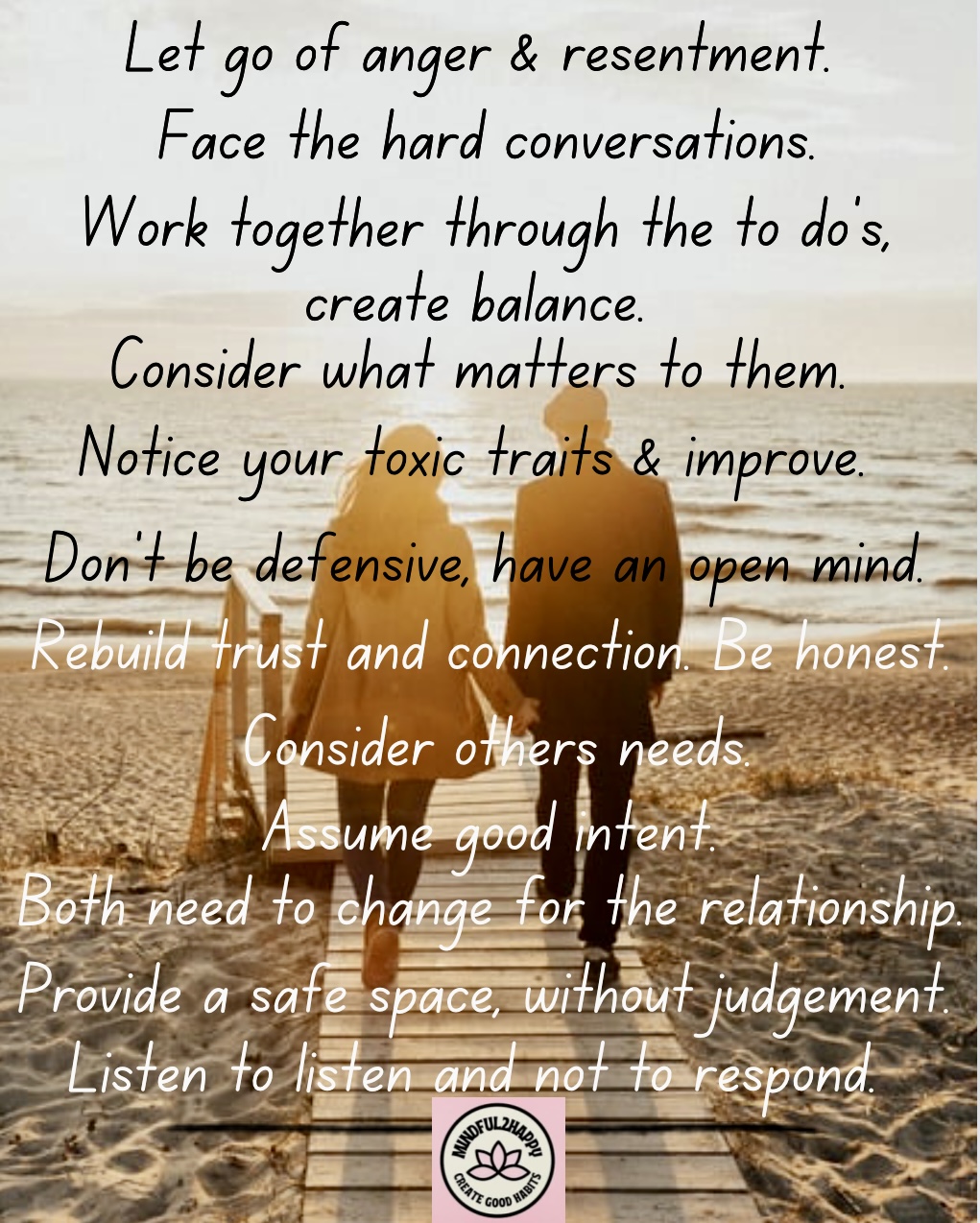 -For more relationship tips, please see more mindful2happy blog posts under the RELATIONSHIPS tab, such as my 13 TIPS TO RECONNECT WITH YOUR RELATIONSHIP blog post.
-For the video that I was shared: https://www.bing.com/videos/riverview/relatedvideo?&q=narcassist+vs+avoidant&&mid=8C23D16865256CC1683C8C23D16865256CC1683C&mmscn=mtsc&aps=30
Good luck on your mindful2happy journey!